Examining Disaster Risk Reduction in Indonesia (2025)
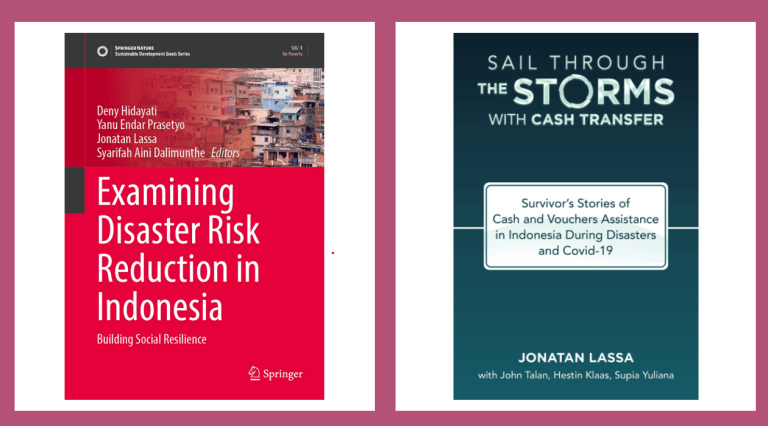
This book offers a critical examination of the global diffusion and local reception of disaster risk reduction (DRR) programs through the lens of Indonesia’s unique challenges and successes. This book critically examines the global diffusion and local reception of risk by implementing Indonesia’s disaster risk reduction (DRR) programs. Global efforts to strengthen local disaster resilience capacities have become a staple of international development in recent decades. Yet, the successful implementation of DRR projects designed to enhance local resilience remains vague. There are pockets of success in the post-2018 Central Sulawesi Earthquake, but a gap nevertheless remains between global expectations and local realities. Through a critical realist study of global and local worldviews of risk in Indonesia, this book argues that the global advocacy of DRR remains inadequate because of a failure to prioritize person-orientated ethics in its conceptualization of disaster resilience. Much of the research and policies on DRR have used social science methods only to complement the technological improvement approach offered in reducing disaster risk, especially in the Global South. This book invites readers to revisit disaster as a social problem and as a social construct. This book emphasizes the importance of social science disciplines to answer extensive topics on DRR—from empirical, theoretical, and philosophical approaches—to provide a critical arena and generate dialogue around a people-centered approach to DRR. Vis-à-vis regional comparison, the authors provide a valuable lens to understand the underlying social structures that make resilience possible and unpack the extent to which local governments, communities, and persons interpret and modify their behavior on risk when faced with the global message on understanding a systemic situation. This book is an essential resource for researchers, professionals, and students in areas of resilience, risk management, development studies, and area studies. It provides fresh perspectives and fostering dialogue on DRR in the Global South.
Sail Through the Storms (2022
“World Humanitarian Summit in 2016 called for humanitarian industries, including the United Nations and NGOs, to bolder promote the use of cash transfers in responding to disasters.
This book documents experiences and collects personal accounts of disasters, COVID-19 and cash transfers from disaster survivors in Indonesia whose lives intersect with other survivors and humanitarian responders, ranging from local activists to NGO’ workers. The survivors are often labelled as ‘project beneficiaries’. Cash assistance and disaster payments are temporary income for the affected community. It is no silver bullet despite their rich potential to reduce vulnerability and suffering. One of the promises of such assistance is that it can help both women and children survive and rebuild their lives after a crisis, be it from a natural catastrophe or man-made hazards. The question is how such assistance is understood in a fuller context of a survivor’s complex life?
To its critics, humanitarian cash assistance is like ‘a drop of salt in the ocean’ in that it is not enough to make a difference to disaster-affected people’s lives.
Nevertheless, the question is how a relatively small-size and temporarily distributed cash assistance within a short time window can significantly impact the beneficiaries’ life at a particular time and places ruined by disasters? Survivors and beneficiaries are not just numbers. They are humans with stories worth listening to. This book shows that to what extent cash assistance can be meaningful, they must be understood in a fuller context of people’s lives, and lived stories, including their wade dreams that go beyond the cold and dry quantitative evaluation measures that are often chasing the numbers with a certain percentage of Yes and No in agreeing or disagreeing about how good and helpful support is to the life of the crisis-affected people.
This book also shows evidence that disaster can cause loss of connection between a citizen (disaster survivors) and the state (governmental agencies) as disasters destroyed the ‘sacred papers’ (the IDs); consequently, state-citizen relation is at risk. Therefore, disasters can create new forms of social exclusion sponsored by state ignorance, as government officials might fail to establish their operations based on humanitarian principles.
Conventional post-disaster aid distribution (in the form of commodity transfers [e.g., food and non-food items]) is grounded in the moral imperative of paternalism, where external actors decide what is best for survivors of disasters and conflicts. The worst form of paternalism is the delivery of used clothes of random sizes from rich countries to low-income countries. Such a form of ‘humanitarianism’ often ends in the landfill of the already distressing solid waste management system, especially after disasters where environmental clean-up takes years to complete.
On the contrary, this book views cash assistance as a more flexible and relatively less-intrusive type of aid that is rooted in the ideology of libertarian paternalism because peoples’ choices towards emergency aid are not ‘coercively enforced’ but creatively embedded in a new practice where people affected by disasters can exercise a higher degree of agency and dignity.”
 Indosasters Lab - JA Lassa